For a step-by-step workflow, read Review context before changing engines. For current provider support, consult Capabilities; this chapter describes reviewed surfaces and their limits.
Provider history
History reads the supported agent's session archive for the project/account. A folder rename can orphan path-keyed archives unless they are migrated. Check identity and working directory before concluding that a conversation was lost.
A session-list row offers Resume in Chat, Copy Session ID and Copy Summary as JSON. The JSON contains the row summary; it is not a transcript export.
In Chat, saved-history browsing keeps a bounded window of source records. Browse saved history offers an explicit entry when shown. A directional request can move unprotected records at the opposite edge out of the displayed window to make room. Reversing direction can load them again from the retained cache or available archive. Moving a record out of this window does not delete it or resume an agent turn.
The reading window contains at most 60 compact reading units, bounded by 800 source records and a 12,000 rendering-cost budget. A saved activity group is one reading unit, with at most 400 source records in one bounded part. Pages target conversational user and assistant messages rather than letting tool records consume the whole message allowance; byte, row and time bounds can still end a page earlier. These are display and read bounds, not token allowances or a promise to load the whole archive at once.
Ordinary page publication preserves the captured reading anchor and protected selection, Find and held-send identities. An explicit Older action can open an earlier whole saved window when the current bounded document is exhausted; an active selection or Find result can prevent that move. Folded groups retain the renderer's exact source mapping, so matching text or positions cannot make unrelated records members of a group.
Consecutive saved tool calls and outputs appear as a compact saved-steps group. Choose View saved steps or View saved activity to open a fixed local snapshot: up to 400 source records, 40 per page, with one bounded excerpt expanded at a time. The snapshot does not update with the chat. Its disclosure explains once that these are saved source records, not complete tool runs; group tooltips retain that qualification too. Missing or truncated source text cannot be recovered by expanding it. Live tool runs keep their own inline expansion behavior.
While browsing, the header reads Viewing saved messages · Back to latest. Open History details for Older, Newer, Retry and source-limit explanations. A known source-limit warning does not stop Older when the source provides an advancing continuation; an unavailable or nonadvancing cursor remains a refusal. Any interruption notice and Continue action are separate from reading saved messages.
At app launch, eligible retained Claude and Codex conversations load the first local history page for the selected tab in each pane first, then at most four other retained tabs, one at a time. This reads saved files without starting a provider turn. It does not replay every retained history at launch; other tabs can load when opened. Private retention, checked-workspace bindings and unavailable source identities have separate admission rules.
Boundary and recovery: Consult the provider capability table for read/resume differences. Unsupported history should be reported as unavailable, not silently treated as an empty conversation. A page change can be refused when the protected span cannot fit the fixed budget, the installed mapping or fresh geometry cannot be qualified, or the requested archive is unavailable. Reaching a display limit does not establish the beginning or end of saved history. Summary and truncated-preview disclosures still apply; browsing does not recover reasoning text absent from the saved source.
Saved-history reading captures a fixed trailing-space claim of at most one admitted viewport for the reading session. The claim first affects native layout on a later source publication, preserving the admitted document while its page is being read. Only separately verified space actually allocated by the owned native document can support its geometry; that space is not another source record. Incoming output keeps reading and the same claim, including any already installed allowance. Back to latest, or a qualified owned downward arrival at the document bottom after a successful restore, returns to latest and removes the allowance. Live and latest views have no allowance.
A focused 42-method native sample and a separate synthetic owned-window capture passed their scoped checks. The explicit older-page case preserved its visible source anchor at 12 points before and after loading, with folded activity retained. These checks do not qualify genuine wheel input, user bottom navigation after resize, active Find or native selected-span UI. Full combined-build and delivery qualification remain separate.
Inspect one named account's history
Replace PROJECT with the exact registered project and DEMO_ACCOUNT with an existing named Codex account. Select a provider/account before interpreting an empty archive.
Read-only inspection.
commandem sessions PROJECT --agent codex --account DEMO_ACCOUNT --jsonExpected result: A provider-qualified session listing for that project/account. Unsupported adapters, missing accounts and unreadable archives are errors or unavailable states, not proof that no conversation occurred.
Read a local display-history page
Use an exact SESSION_ID from the selected account. Claude and Codex support this local paging path; it starts no model turn.
commandem sessions PROJECT --agent codex --account DEMO_ACCOUNT --session SESSION_ID --view --page --limit 40 --jsonExpected result: One local display-history page with its source identity, limits and continuation metadata. Read that metadata before continuing. To request an older page, repeat the same project, provider, account and session with --before CURSOR, using the opaque continuation returned by that page. Do not invent or reuse a cursor for another source. Missing, changed or unreadable archives remain errors or explicit limited states, not proof that the session began at the first row you can see.
Native resume versus bridge
Native resume continues a source-provider session under its owning account. A cross-provider bridge transfers reviewed evidence into a different conversation; it does not grant the destination ownership of the native transcript.
Extra chat tabs begin fresh. In an empty extra chat, Resume latest checks the selected provider/account’s project history. It reports a missing or already-open latest session rather than silently selecting an older one. Confirm the destination identity before sending.
Boundary and recovery: Changing provider or account may require a bridge. Start clean means no bridged payload; a stale or mismatched preview must be reviewed again.
- Match identity
Check project, provider, account and source session.
- Choose the path
Resume an owned native session, or preview evidence for a different conversation.
- Review before sending
Approve a current bridge, or choose Start clean to transfer no payload.
Context inspector and manifest
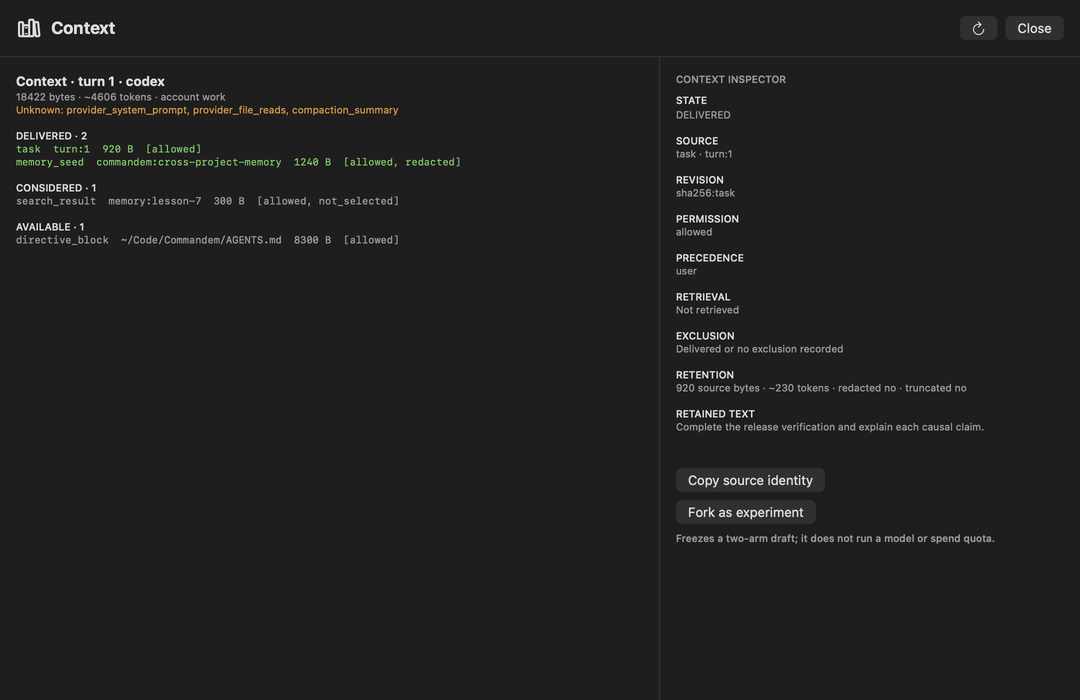
Inspect which sources were selected, included, excluded or truncated in a context manifest. The Context inspector opens as a pane in the main window, not a sheet. Source identity, revision, privacy provenance and payload accounting explain what the destination could receive.
Availability, selection and delivery are different evidence states. Matrix counts a file reference as delivered context only when its entry is marked delivered, allowed and without an exclusion. Discoverable project guidance remains availability evidence. Even recorded delivery does not prove that the provider read, edited or successfully used the file.
Boundary and recovery: A token estimate is an estimate. A manifest is not a model's attention trace and cannot prove how a model used the supplied information.
Inspect one request boundary
Replace RUN_ID with a recorded run or session that has a captured manifest. The positional 1 selects turn one; choose a real positive turn number for the record you are inspecting.
Read-only inspection.
commandem context-inspect RUN_ID 1Expected result: The stored manifest as JSON, including known selections, exclusions and accounting. No manifest is an explicit error. This does not rerun the turn or prove which supplied facts influenced the model.
Reviewed handoff
Select candidate evidence, inspect the preview, remove irrelevant material and approve a current handoff. The transition contract binds plan, preview, review and current state to the payload and manifest draft.
Boundary and recovery: Redaction precedes truncation. Credentials and untrusted instructions must not become authority; changed evidence invalidates the earlier review.
Matrix labeling and learned models
Human labels judge whether two conversations share useful objectives or evidence, not whether their wording looks similar. Related pairs should help continue actual work; insufficient evidence can be skipped. Cross-provider examples need deliberate coverage.
Boundary and recovery: A labeling queue is not an active trained model. See Matrix workspace scope and dated research evidence. Offline research qualification uses human judgments, topology coverage and held-out evaluation. Those checks do not complete the separate ordinary-use learning and online promotion loop, which is not yet implemented end to end. Do not imply that deterministic Matrix is a GNN.
Successful commandem sessions --learning-status --json reports ordinary_use_pipeline implementation capability. Whole-bundle usefulness evidence is connected for explicit Useful / Distracting / Stale ratings when the exact retained capture chain and current participation checks qualify. This is a separate delivered_bridge_usefulness_v1 target, not a label for each included conversation. Candidate-only fitting and automatic promotion remain unimplemented. The separate explicit --train-links action trains and activates the human-relatedness corpus's local linear logistic link scorer; it is neither a shadow usefulness fitter nor a GNN.
The same status includes bundle_usefulness: bounded read-only counts of retained observations, outcomes, distinct scopes and re-rated scopes. Absent, busy, unsafe and incomplete state are distinct; unqualified scans omit evaluated counts. Immutable best-effort history is not the authoritative latest feedback, a training dataset or a coverage denominator. Source capability does not inspect current project opt-in; each evidence attempt separately rechecks the destination and every offered source project, including unselected entries. The original feedback result is printed before the shared one-in-flight recorder waits at most its configured 20ms caller budget; unavailable or revoked metadata skips evidence without adding an alert or refusing the rating. No model is fitted, activated or ranked differently by this connection.
Training readiness also requires every label to carry the current link-feature revision and a finite similarity in the inclusive range [0,1]. Old, mixed or future label revisions, and invalid supplied similarity values, leave the corpus unready with a categorical blocked reason; existing provenance, diversity and balance checks still take precedence. These decodable incompatible rows are not silently dropped or rewritten. This admission check neither rewrites historical labels nor changes the currently active model. A compatible feature revision establishes input compatibility, not usefulness or model quality.
For Claude Matrix features, a scanner error before the accepted 200 UUID-bearing user/assistant records excludes that source from new graph input rather than accepting partial features. The per-token limit remains 8 MiB; invalid JSON and records without UUIDs do not consume the record cap, so it is not a total byte, line or time bound. The next ordinary normal refresh reparses old Claude feature-cache entries under the new parser revision. Compatible historical graph projections can remain readable until refresh; the history picker remains a separate best-effort parser.
Live learned scoring accepts only the current model schema and feature revision, the expected finite weights and a usable version identifier. Loading an incompatible active artifact reports an error; applying it leaves deterministic scores unchanged. These checks establish compatibility, not model quality. An older cached graph cannot establish which model is currently admissible.
Fresh internal Matrix graphs retain the similarity scorer revision, callback attempts, usable embeddings and actual cosine or lexical pair counts. Their optional lexical_summary_coverage names the existing ASCII tokenizer and counts empty, thin, meaningful and repeated meaningful summary representations. It reports available lexical coverage rather than language accuracy, suppressed-pair counts or improved scoring; older absent metadata remains unknown. Direct graph serialization includes this scorer record; the current sessions --graph CLI JSON projections select other fields and omit it. An unavailable or malformed embedding affects only pairs involving that item; mismatched dimensions fall back for that pair. Failure causes are content-free, and unverified backend or model identity stays unknown. Callback attempts may be cache hits, not provider requests. Older cached graphs can lack this record; reading a compatible cached graph projection does not rescore it or train a model.
Transition plans and bridge previews can carry an optional graph-wide observation of the base similarity calculation into reviewed context manifests. It distinguishes recorded cosine, lexical and fallback pair counts for the whole graph build; these are not selected-candidate scores or provider-request counts. A learned overlay remains separate, and existing transition labels and per-candidate ranking metadata keep their meanings. Older records can omit this observation. A newly observed graph with absent provenance reports legacy_unknown; unsupported or malformed source provenance reports invalid_recorded unknown metadata without changing selection or blocking the transition. New observations remain bound by the existing plan and preview integrity checks. This adds no refresh, training, activation or new privacy permission.
Matrix binds embedding-cache reuse to a configured-space snapshot taken once per graph build. It distinguishes declared model and endpoint identity, or Apple helper contents and requested mode; these do not attest actual provider weights, the effective Apple fallback engine or model revision. Each cached vector carries its observed dimension. Legacy caches with unknown space are not reused; a normal refresh with embeddings configured regenerates the needed vectors lazily. Reading a compatible cached graph projection does not rebuild vectors or probe the backend. If the projection is unavailable but its saved inventory is compatible, cached-only loading can reconstruct a graph through the existing embedding and cache path without scanning provider transcripts. A malformed row under a matching cache header is refused without automatic retry or repair; only pairs touching that item fall back to lexical scoring. JSON build_stats.embedding_cache reports categorical cache-load admission and refusals from that build. Its namespace state describes the header seen at load time, even if a save followed; it does not certify disk publication, ongoing cache health or actual runtime identity.
Matrix degree counts retained relationships, including parallel shared-file relationships; it is not a count of distinct neighbors. Weak components include retained similarity and file relationships, while root flags reflect lineage only. The known earlier delivered-file projection format can repair its annotations in memory when its inventory timestamp matches, without rescanning transcripts or changing evidence and scores. Unknown or incompatible snapshots are not reused; a transition preview may ask you to refresh Matrix. Ordinary fresh Matrix refresh attempts to persist the current projection; cached-only repair stays in memory. Refreshing does not train or activate a model.
The existing commandem sessions --learning-status --json also reports refresh_attempts: bounded, content-free observations of completed normal refreshes. Graph completion, inventory publication and projection publication are separate outcomes; per-project refresh does not publish the global index. Cached-only reads create no observation. The ledger is not exhaustive: busy or failed telemetry writes, interrupted processes and killed or dropped attempts can leave no record. Origin and hidden provider coverage remain unknown; missing records do not establish that no refresh ran or that a graph is current. Reading this status does not refresh Matrix, train or activate a model.
Causal investigation and memory
Replay, context provenance and project memory help reconstruct trigger, evidence, mechanism, change and measured effect. Use source-backed links and state confidence explicitly when recording a lesson.
Boundary and recovery: Sequence alone is not causation. Unknown mechanisms should prompt instrumentation or a controlled test, not an unverified fix presented as proven.
Find a prior objective without resuming it
This searches registered conversation archives. The query is an example, not a project selector. The --since flag uses a Go duration; --max limits matching turns per session, not the number of sessions searched.
Inspection with possible local summary-cache writes.
commandem chatsearch --role user --since 168h --max 5 "acceptance criteria"Expected result: Ranked, bounded matches with provider/session/project provenance. Inspect the source before treating a snippet as a current decision; no chat resumes and no model is invoked. Reading Claude archives can refresh local transcript-summary sidecars. Source transcripts are not edited, and this form makes no provider request.
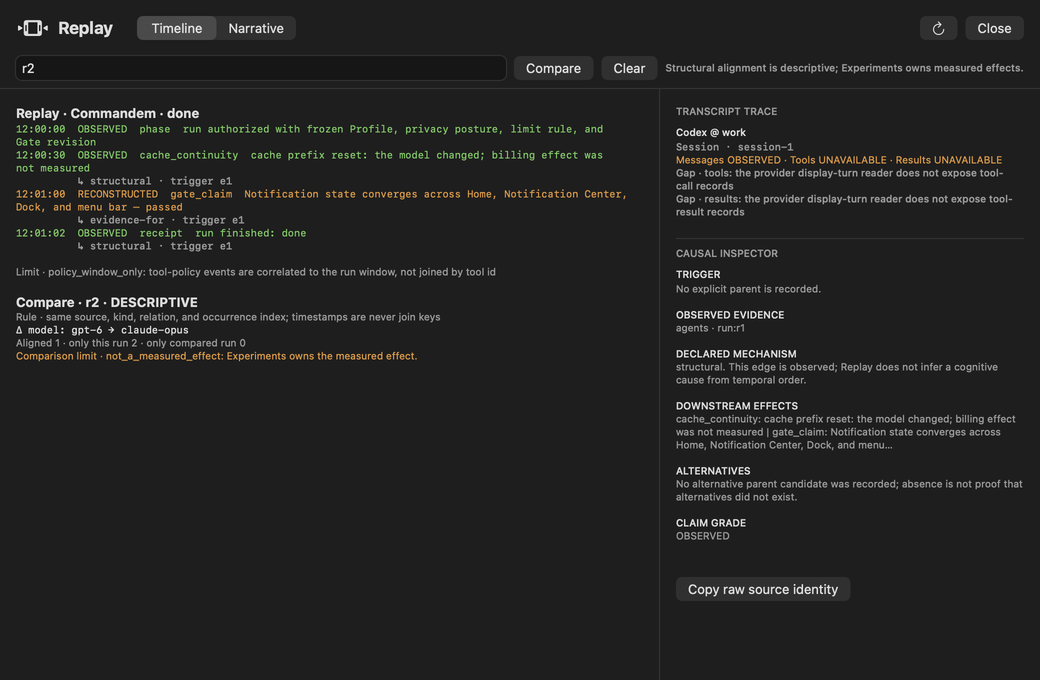
Replay inspection and run receipts complement the context manifest. They answer different questions.